

Walk from the Police Museum/Technical Museum at Gärdet to Prince Eugen’s Waldemarsudde. The walk takes about an hour.
- Walk from the Police Museum/Technical Museum at Gärdet to Prince Eugen’s Waldemarsudde. The walk takes about an hour.
- Museivägen 7 – Colonel Wennerström’s treason is displayed here
- Lidovägen Dragongården. Himmler’s SS general was hidden with the king’s nephew
- Djurgårdsbrunnsvägen 54. Behind the squinting salon lion was a British master spy, James Bond type
- Djurgårdsbrunnsvägen. The Russian spy is a regular at Djurgårdsbrunn
- Rosendalsvägen. Did the spy colonel have secret meetings in the bushes? Or a ”mailbox” in an oak tree?
- Bellmansro, charming outdoor seating for discreet meetings
- Djurgårdsvägen 174, Oakhill. Tailor used scissors to kill Italian ambassador
- Prins Eugens väg 6, Waldemarsudde. The king was a German lover, his painter brother an anti-fascist who supported the city’s resistance movement.
Djurgården was noted in the intelligence activities of the Security Police. According to the Security Police’s secret ”spy map” from the 1960s, which was top secret for over 50 years, the forest areas on and around Djurgården were included in the mapping of spy-related observations. security police
Museivägen 7 – Colonel Wennerström’s treason is displayed here
The museum offers guided tours of Wennerström’s life as a spy. Every Saturday and Sunday at 2 p.m. See objects from Wennerström’s life with parts of his equipment, such as a spy camera. The tour tells how the colonel was exposed with the help of his housekeeper, recruited as an agent by the Security Service. < Wikipedia > < GoogleMaps > < Streetview >

The Police Museum is housed in the old stables of the K2 regiment. In addition to this cavalry regiment, an artillery regiment and the Svea Life Guards practiced at Gärdet, up towards the shooting ranges at Kaknäs. The Soviet intelligence officer Sidorenko visited the area and asked questions of the soldiers.
When war broke out in 1939 and in connection with the large increases in forces in 1940–1941, the permanent barracks were not enough. Large parts of Gärdet were periodically filled with tent camps for the accommodation of mobilized conscripts. The area was also used for the parking of military vehicles, horse-drawn ropes and storage facilities while waiting for the troops to be transported to their war positions on the coast or borders.
Lidovägen Dragongården. Himmler’s SS general was hidden with the king’s nephew
Count Folke Bernadotte lived there with his family (including his wife Estelle) from the early 1930s. The property, located on Norra Djurgården near the Museum Park, was later taken over by the state and today serves as the residence of the Chinese ambassador . < Wikipedia > < GoogleMaps > < Streetview >
During the spring of 1945, Dragongården was the scene of secret planning work for Aktion Vita bussarna, the rescue operation for concentration camp prisoners in Germany. It is said that the phones at Dragongården rang around the clock. Since the operation was sensitive and required direct contact with both the Swedish government and German authorities (including Heinrich Himmler), the home’s library and study served as a kind of informal command center. While the children played in the garden, Folke sat in meetings with military personnel, Red Cross officials, and diplomats to coordinate the routes of the bus convoys.
Walter Schellenberg — head of the German RSHA’s foreign intelligence service (SD-Amt VI) and SS-Brigadeführer — was given temporary shelter and accommodation in Folke Bernadotte’s home Dragongården in early May 1945. The stay was short but significant: it gave Schellenberg a secure base after Germany’s collapse, the opportunity to present his version of events and later prepare his defense before the Allies.
- Instead of being put in a regular internment camp, the SS general was received by Folke Bernadotte and accommodated for a few weeks as a private guest at Dragongården .
- In order not to attract attention from journalists and the curious, Schellenberg needed civilian clothes instead of the SS uniform. The young Swedish Foreign Ministry official Sverker Åström was assigned to take “The Diplomat” Schellenberg to the NK department store to obtain a civilian wardrobe at the expense of the Swedish state/Foreign Ministry.

Bernadotte and Schellenberg had worked closely together in negotiations within the framework of the Swedish Red Cross rescue operations, the so-called white buses. Schellenberg participated in negotiations regarding Scandinavian prisoners and was one of the German actors whom Bernadotte met in Berlin.
- Schellenberg simultaneously worked to get Heinrich Himmler to negotiate with the Western Allies via Bernadotte, and he arranged, among other things, the transport of Jews to Switzerland and Sweden. He himself traveled to Stockholm in April 1945 to prepare these contacts. wikipedia
- Schellenber flew on the morning of May 6, 1945, from Copenhagen to Malmö in one of Bernadotte’s Red Cross planes, then to Stockholm in a Swedish bomber.
- Near the count’s former home is the pedestrian path Folke Bernadottes väg and the newer Folke Bernadottes bridge , which spans Djurgårdsbrunnsviken.
Djurgårdsbrunnsvägen 54. Behind the squinting salon lion was a British master spy, James Bond type
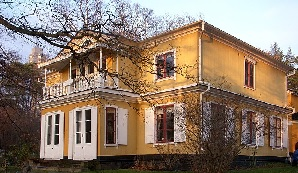
Before October 1943, British “press attaché” Peter Tennant lived at Bergshyddan not far from the Djurgårdsbrunn inn. Ingrid Bergman lived at Bergshyddan before she went to Hollywood. Peter Tennant was one of the central British intelligence officers in Stockholm during World War II. He officially served as press attaché at the British legation, but at the same time led the Swedish operations of the British sabotage and resistance organization SOE (Special Operations Executive). < Wikipedia > < GoogleMaps >
Bergshyddan – which had previously been home to Ingrid Bergman before her Hollywood career took off – functioned during Tennant’s time as a charming and strategic cover and gathering place. At Bergshyddan, he lived a socially outgoing life with his Swedish-born wife Hellis (née Fellenius). He invited prominent Swedes, cultural workers and diplomats to his home for dinners and dinner conversations. His guests were often led to believe that they were simply socializing with a literary-interested and pleasant British cultural and press attaché, while in reality Tennant was building up contacts for sabotage and resistance networks in occupied Norway and Denmark.
Secret agents do not like to be seen. Tennant, on the other hand, paddled in a CD-marked (Corps Diplomatique) canoe from his home at Djurgårdsbrunnsviken to the legation in Diplomatstaden at Strandvägen 82 (now Dag Hammarskjölds väg 20), where he was head of sabotage and espionage at SOE (Special Operations Executive) . In the same spirit as his fictional colleague James Bond at MI6, Tennant also used humor in his work. One example was spreading bran powder in the underwear of high-ranking German military personnel at the Grand Hôtel. His social skills contributed to his cover, which was the name Karlsson.
With humor and charm, Tennant was a popular guest when prominent Swedes hosted dinners and sailing trips. He spoke perfect Swedish. He probably ate at the nearby Djurgårdsbrunn Inn, the tavern where Raoul Wallenberg planned his trip to Budapest with American diplomat Ivers Olsen.
Djurgårdsbrunnsvägen. The Russian spy is a regular at Djurgårdsbrunn
In April 1942, Soviet intelligence officer Vassilij Sidorenko was under surveillance by Swedish counterintelligence. The Russian had taken a liking to the daughter of the Swede Wallin, who frequented the Djurgårdsbrunn inn. There he tried to force her to provide secret information about the Swedish military in exchange for money. < Wikipedia > < GoogleMaps > < Streetview >

GRU agent Sidorenko came to Stockholm in 1940 under the guise of being the head of the Russian tourist agency Intourist. He secretly recruited Swedish informants to gain access to information about the Swedish armored defense.

- Sidorenko began a relationship with a young Swedish woman, Margot Wallin, whose brother (Sergeant Fritiof Tobias Wallin) was delivering secret military information about Swedish tanks to the Russians.
- According to police interrogations, Sidorenko courted the woman diligently and invited her and her mother, Ingeborg, to expensive restaurants around the city. Djurgårdsbrunn Inn was one of the places where they had lunch and where Sidorenko, in dramatic fashion (and tears), declared his love.
- Sidorenko was arrested by the Swedish Security Police in September 1942 and sentenced to 12 years of hard labor. However, he was pardoned in February 1944 – just three days after the mysterious Soviet bombings of Stockholm and Strängnäs , which has led to historical speculation that the bombings were in fact Russian pressure to have him released.
- The inn was destroyed in a fire in 1987. The place has lived on through extensions and new ventures.
Rosendalsvägen. Did the spy colonel have secret meetings in the bushes? Or a ”mailbox” in an oak tree?
Djurgården has an unusually clear connection to Stockholm’s intelligence and security history, especially during World War II and the early Cold War. The Swedish Security Service has published its previously secret spy map from the 1960s . It shows that the forest areas were repeatedly used for suspicious meetings and other spy-related activities. Säpo explicitly states that their spies observed Wennerström on Djurgården in the early 1960s.

< Google Maps > < Streetview >
Air Force Colonel and GRU spy Stig Wennerström is the most famous example. During the 1950s and 1960s, Djurgården was the most important meeting place for his contacts with Soviet intelligence officers. Wennerström was observed on Djurgården on several occasions in the early 1960s by Säkerhetspolizei spies. One case occurred in September 1961. Säpo spies saw Wennerström driving out to Djurgården during a lunch break. His red car was parked next to Rosendalsvägen, while Wennerström himself had disappeared from sight.
Contact often took place through seemingly innocent Sunday walks along the Djurgård Canal. Wennerström would meet his Soviet handlers on foot to exchange information or check hidden “letterboxes” (dead drops).
It was through intensive Säpo surveillance on Djurgården that Wennerström’s movement patterns were mapped. In June 1963, after his maid found hidden spy films, he was finally arrested on Riksbron on his way to work, but the groundwork for the arrest was laid during the months of shadowing on Djurgården.

Bellmansro, charming outdoor seating for discreet meetings

Bellmansro was a place for discreet meetings for diplomats, military attachés, businessmen and cultural figures. The restaurant with separate dining rooms ( chambres séparées ) and a magnificent outdoor terrace was run during the war years by restaurateur Sten Hellberg. < Wikipedia > < GoogleMaps > < Streetview >
At Bellmansro, diplomats and agents from the warring powers – both Allied and Axis representatives – could move around under cover. The location’s seclusion made it ideal for handing over documents, conducting exploratory talks and recruiting.
- The Security Service’s surveillance agency kept restaurants like Bellmansro, Hasselbacken, and Cecil under constant surveillance. Scouts shadowed suspected foreign agents to and from the restaurant, noted who sat at the table together, and what license plates appeared in the parking lot.
- It was not uncommon for the security service to have informants among restaurant staff, butlers and drivers to get tips on which guests had booked individual rooms or who paid for grand dinners.
In May 1952, the restaurant burned down and was completely destroyed by a second fire in 1955. Today, only the Bellman bust and the place name remain on Djurgården.
Raoul Wallenberg
In the spring of 1944, the American organization War Refugee Board (WRB) was looking for a suitable person to send to Hungary to save the Jewish population from the Holocaust. The American diplomat Iver C. Olsen (who formally represented the WRB but also belonged to the American intelligence service OSS) met Raoul Wallenberg during a dinner at the Bellmansro restaurant on April 17, 1944. The meeting was arranged through Wallenberg’s business partner, the Hungarian Kalman Lauer.
At Bellmansro, Wallenberg also met the American diplomat Herschel Johnson shortly before his departure for Budapest in July 1944. The meeting is said to have been about his upcoming humanitarian mission. Johnson worked at the American legation in Stockholm and was involved in issues of refugee aid. In Budapest, Wallenberg received support from the Swedish legation. American initiatives organized protection for Jews who were threatened with deportation and persecution.
Djurgårdsvägen 174, Oakhill. Tailor used scissors to kill Italian ambassador
The Embassy Murder took place on 25 December 1947 inside the Italian embassy in Villa Oakhill. When the Italian ambassador Alberto Bellardi Ricci (1892–1947) was stabbed to death by Giuseppe Capocci (1908–1954), an Italian man living in Sweden. The perpetrator, who was mentally ill , was sentenced to closed psychiatric care and deportation to Italy . < Wikipedia > < GoogleMaps > < Streetview >
On Christmas morning, December 25, 1947, the Italian envoy (ambassador) Alberto Bellardi Ricci was at the residence at Villa Oakhill. At 11 a.m. the doorbell rang. Outside stood 38-year-old Italian tailor Giuseppe Capocci , who demanded to see the ambassador. Capocci was admitted and received by the legation secretary Gian Gaspari Cittadini-Ceci and ambassador Bellardi Ricci. Capocci began to make confused complaints about his passport documents and his financial situation.
When the ambassador tried to calm him down, Capocci suddenly pulled out one half of a pair of tailor’s scissors that he had sharpened. He stabbed Bellardi Ricci severely in the chest and throat. The legation secretary tried to intervene and was also injured, before staff and finally the police who were called managed to overpower the perpetrator. Alberto Bellardi Ricci was rushed to hospital but died in the ambulance from his injuries.

Giuseppe Capocci was a Swedish resident and tailor, but suffered from severe paranoia of persecution and psychotic delusions. Capocci had come to believe that the Italian mission was monitoring him, working against him, and holding money or documents to which he felt entitled.
Prins Eugens väg 6, Waldemarsudde. The king was a German lover, his painter brother an anti-fascist who supported the city’s resistance movement.
The Tuesday Club took a special position as an anti-fascist network during World War II. Prince Eugen (1865–1947), known as the “Painter Prince”. He did not attend the meetings, but was an important ally behind the scenes. His position gave him a certain protection. Therefore, the prince could speak out openly against the Germans and Nazism without risking reprisals like ordinary citizens. < Wikipedia > < GoogleMaps > < Streetview >
Amelie Posse led the club with famous names such as the author Wilhelm Moberg and the cabinet minister couple Alva – Gunnar Myrdal . Most sensitive was the secret member Else Kleen , journalist and wife of the Minister of Social Affairs Gustav Möller. Together with his state secretary Tage Erlander, the minister was responsible for putting communists in internment camps.

The Tuesday Club was secretly formed in January 1940, shortly after the outbreak of the Finnish Winter War, at the initiative of the writer Amelie Posse. The club brought together a motley crowd of intellectuals, writers, artists, scientists, politicians and publicists who shared an unwavering conviction: Sweden must defend its democracy, distance itself from Nazism and actively support its neighboring countries – above all Finland and occupied Norway and Denmark.
- The club had provided information about suspected Nazis to the authorities, which the security police perceived as competing intelligence activities. The Tuesday Club’s phones were tapped by the Swedish security service, probably also conversations with Prince Eugen, but there is no evidence of this,
- The group met on Tuesdays, first in private homes, later in premises connected to the members. They analyzed the situation, exchanged information and discussed refugee aid. They wanted to counteract the pro-German public opinion and the concessions of the Swedish coalition government under Prime Minister Per Albin Hansson. Eugen contributed financial support and gave legitimacy to the anti-Nazi activities.
Since Eugen was the king’s brother, his involvement was politically sensitive. Gustaf V socialized with Nazi leaders. One example was when he invited the leader of the Swedish National Socialist Party, Sven Olov Lindholm, to the castle. The king presented a Swedish award to Hermann Göring in Berlin in 1939, in the midst of Nazi oppression. During the Midsummer Crisis of 1941, the king supported Germany’s demand to bring the Engelbrecht Division by train through Sweden from Norway to Finland. He is said to have threatened to abdicate if the government said no.
- Prince Eugen lent his unwavering democratic convictions to the club. He never hid his contempt for Nazism and German fascism, making him a symbol of the national will to resist.
- Through his position and his enormous network of contacts, he was able to act as a door-opener and a unifying force. His home in Waldemarsudde became a free zone where cultural figures and resistance fighters could meet without preconditions.
- The prince was deeply involved in humanitarian efforts, using his position to quietly support Nordic refugees, including Norwegian and Danish intellectuals fleeing Nazi persecution.
/ By Ingemar Lindmark
